Search This Blog

Google

Showing posts with label Chapter 4 Numerical. Show all posts

Tuesday, 25 December 2012

P.No. 4.6:- 100meter cube of water is pumped from a reservoir into a tank, 10m higher than the reservoir, in 20 minutes. Find (a) The increase in P.E (b) The power delivered by the pump.


P.No.   4.6:- 100m³ of water is pumped from a reservoir into a tank, 10m higher than the reservoir, in 20 minutes. Find

       (a)  The increase in P.E

       (b)  The power delivered by the pump.

Solution:-

Given data:-

                 Volume of water   = V =     100m³

                  Height                  = h =      10m

                   Time taken          = t =      20min   =   20 × 60s   = 1200s

To determine:-

                          Potential energy =   P.E =?

                           Power                 =   P    =?

Calculation:-

 ( we know that work done is equal to change in energy it may be kinetic or potential but  in this case only P.E is involved. So,)

                 Work done = Increase in P.E     

                                    = mgh

                To determine mass ‘m’ we first take

                     Density = mass/volume

   Or,                 ρ = m/V


Sunday, 16 December 2012

P.No. 4.6:- 100m³ of water is pumped from a reservoir into a tank, 10m higher than the reservoir, in 20 minutes. Find (a) The increase in P.E (b) The power delivered by the pump.

P.No.    4.6:- 100m³ of water is pumped from a reservoir into a tank, 10m higher than the reservoir, in 20 minutes. Find (a) The increase in P.E (b) The power delivered by the pump.  
Solution:-
Given data:-
                 Volume of water   = V =     100m³
                  Height                  = h =      10m
                   Time taken          = t =      20min   =   20 × 60s   = 1200s
To determine:-
                          Potential energy =   P.E =?
                           Power                 =   P    =?
Calculation:-
 ( we know that work done is equal to change in energy it may be kinetic or potential but  in this case only P.E is involved. So,)
                 Work done = Increase in P.E     
                                    = mgh
                To determine mass ‘m’ we first take
                     Density = mass/volume
   Or,                 ρ = m/V


Saturday, 15 December 2012

Problem .No. 4.8:- How large a force is required to accelerate an electron (m = 9.1×10 raise to power -31 kg) from rest to a speed of 2.0 × 10 raise to power +7 m/s through a distance of 5.0cm?


P.No.4.7:- A force (thrust) of 400N is required to overcome road friction and air resistance in propelling an automobile at 80km/h. What power (kW) must the engine develop?


P.No.4.7:-   A force (thrust) of 400N is required to overcome road friction and air resistance in propelling an automobile at 80km/h. What power (kW) must the engine develop?
Solution:-
Given Data:-

                      P = 8.9 × 10³ W         (J/s = W   &    10³ =  1k)               
                      P = 8.9 kW         Ans:                       

Problem No.4.5:- A 1000 kg automobile at the top of an incline 10m high and 100m long is released and rolls down the hill. What is its speed at the bottom of the incline if the average retarding force due to friction is 480 N?


Problem No. 4.4:- A car of mass 800 kg traveling at 54 kmph is brought to rest is 60m. Find the average retarding force on the car. What has happened to original kinetic energy?


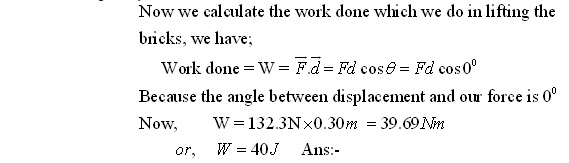
Problem No.4.3:- Ten bricks, each 6.0 cm thick mass 1.5kg, lie flat on a table. How much work is required to stack them one on the top of another?


Problem No.4.3:-  Ten bricks, each 6.0 cm thick mass 1.5kg, lie flat on a table. How much work is required to stack them one on the top of another?
Solution:-
Given Data:-
To Determine:-
    Work done by placing them one on the top of another = W =?
Calculation:-
   Now first of all suppose that all bricks are on the ground. Now you lift a brick i.e.; 2nd and placed it on any one of them which is 1st, now they are two bricks, after that you lift a third one and placed it on the other two, and so on.
Now think for a while that when you lift 2nd brick and placed it 1st brick then 1st brick remain on its place and you never do any work to lift it.
So, we conclude that we work done only on 9 bricks and not on the 10th which is basically the 1st brick.
          Hence,            
                                             Total weight of 9 bricks = w = mg
 After that when you manage the all of these bricks then, their height is 60cm but their combined center of gravity is 30cm.      


Problem No. 4.2:- A raindrop falls vertically at a constant speed under the influence of the forces of gravity and friction. In falling through 100m, how much work is done by (a) gravity and (b) friction?


Problem No. 4.1:- A man pushes a lawnmower with a 40N force directed at an angle of 20 degree downward from the horizontal. Find the word done by the man as he cuts a strip of grass 20m long

Problem No. 4.1:-   A man pushes a lawnmower with a 40N force directed at an angle of  200 downward from the horizontal. Find the word done by the man as he cuts a strip of grass 20m long.